Thursday, July 24, 2014
Final Project
Final Project: I created a picture book, entitled The Queen, the Prince and the Evil Witch.
Activity Guide

Sunday, July 20, 2014
Rough Draft- Picture book
Rough Draft
Here is the rough draft of my picture book.
My five year old daughter wanted to help me write my picture book. She gave me the dialogue for the story as well as searching through the images that match the story. I will need to make a few revisions of the story based on my own review of the picture as well as the peer and instructor comments.
Summary
The story is about a queen named Brooklyn looking for the love of her life. She meets a mermaid and an evil witch. The evil witch captures a handsome prince. The mermaid helps the queen find the prince and they live happily ever after.
Illustrations
I used the images from story bird to create my story. I tried to use the images that best fit the words of the story. The images of Queen Brooklyn changes throughout the story because of her adventures and feelings.
Vocabulary
The vocabulary in the story is simple words and sentences. My five year old daughter assisted me in the writing of the story. I would shelf this book in the school age section.
Extending the Text
(I could use suggestions here)
Comparing Literature
I am still searching for books that would relate to this story. The subject areas you could use are
oceans, queens, prince, witches, and fairy tales.
Science
Research the ocean by using non-fiction books. Are mermaids real? Activities: explore with sand, add a fish tank to the classroom, or count sea animals.
Art
Explore with watercolors, ask children to draw a picture of the ocean or their favorite queen, prince or evil queen.
Dramatic Play
In the dramatic play area, the children can dress-up as a princess, queen, prince, king or evil witch. Another idea is to use puppets to act out the story.
Here is the rough draft of my picture book.
My five year old daughter wanted to help me write my picture book. She gave me the dialogue for the story as well as searching through the images that match the story. I will need to make a few revisions of the story based on my own review of the picture as well as the peer and instructor comments.
Summary
The story is about a queen named Brooklyn looking for the love of her life. She meets a mermaid and an evil witch. The evil witch captures a handsome prince. The mermaid helps the queen find the prince and they live happily ever after.
Illustrations
I used the images from story bird to create my story. I tried to use the images that best fit the words of the story. The images of Queen Brooklyn changes throughout the story because of her adventures and feelings.
Vocabulary
The vocabulary in the story is simple words and sentences. My five year old daughter assisted me in the writing of the story. I would shelf this book in the school age section.
Extending the Text
(I could use suggestions here)
Comparing Literature
I am still searching for books that would relate to this story. The subject areas you could use are
oceans, queens, prince, witches, and fairy tales.
Science
Research the ocean by using non-fiction books. Are mermaids real? Activities: explore with sand, add a fish tank to the classroom, or count sea animals.
Art
Explore with watercolors, ask children to draw a picture of the ocean or their favorite queen, prince or evil queen.
Dramatic Play
In the dramatic play area, the children can dress-up as a princess, queen, prince, king or evil witch. Another idea is to use puppets to act out the story.
Sunday, July 13, 2014
Create a Picturebook
My Picturebook.
1.) Identify the image that in your opinion is the most effective in developing the story as a whole and explain why it was effective. In my opinion, I think the image of Dorothy, the Scarecrow, the Tin Man and the Lion is the most effective image in developing the story as a whole. The line that is attached to this image reads "For a very special purpose." In the story of the Wizard of Oz, Dorothy's purpose is to find a way home but she had the power to go home whenever she wanted. She needed to learn that "if never searched for her heart's desire that she never had to look any further than her own back door."
2.)Did the image and written narrative interact in a way the created irony, metaphor and/or metonymy? The first image is ironic because the line from the poem is "Life is given to each human being," but the people in the image look "scared to death." The last image of a boy taking a selfie, this a metaphor. The line from the poem is "Must discover for himself."
3.) Explain how two or more elements in the illustration help support and develop the story. The looks in the characters eyes help support the development of the story. The illustrations do not exactly match the story but they help to create irony. The third image the character's facial expression shows her showing a surprised face as if she just heard a big secret. The line reads "This secret each human being."
4.) Identify two elements that are repeated throughout a majority of the images. Explain how these elements support the story. The use of facial expressions and colors are repeated throughout a majority of the images. All of the images are bright in color and bring out of the facial expressions of the characters.
Sunday, July 6, 2014
Picturebook Review
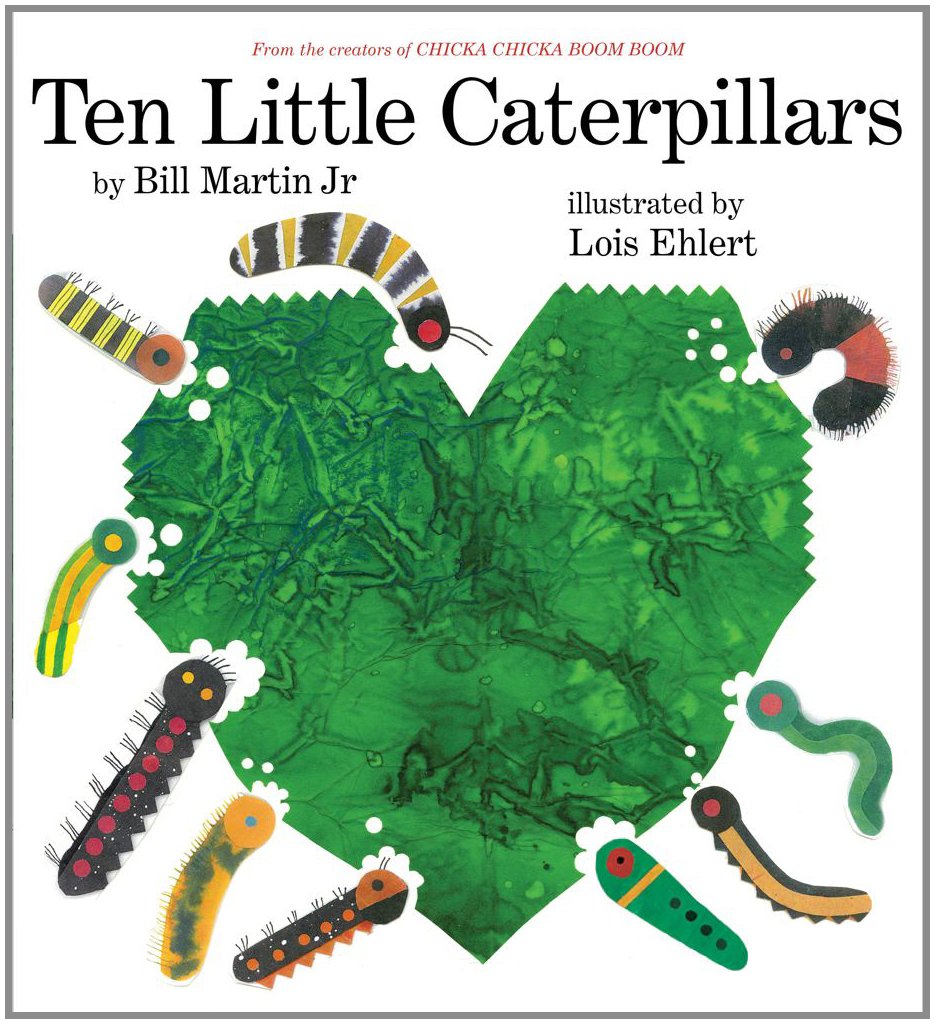
Picturebook Review of Ten Little Caterpillars by Bill Martin Jr.
Text
1. The text of a children's book is usually organized into simple sentences and short paragraphs. How is the text organized in the book that you have chosen to review? Explain whether this organization was sufficient for the story that this book is telling. The text in Ten Little Caterpillars is organized with short simple sentences. One sentence that spreads around two pages. Yes, the organization of the sentences is sufficient to the telling of the story, because it is a math-based picture book. Each page is based on one number.
2. Children's book authors often employ literary tools to help make the story more vivid in the readers minds. Commonly used literary tools are rhythm, alliteration, repetition, refrains, onomatopoeia, simile, personification, rhyme, and imagery. Identify three different areas in the text where a literary tool has been employed. For each example you identify, state the type of literary tool that is used and how the employment of the tool helps support the story. The three different literacy tools that were employed in this story were refrains, repetition, rhyme and rhythm.
- Refrains were used in the story by the use of rhyming words and the end of a sentences.


- Rhymes were used throughout the book. The last word of the sentence rhymes with the last word of the next sentence.
- Repetitions were used in the story by repeating the rhymes throughout the story.
- Rhythm and repetition can go hand in hand in this story depending on how you read the story. This is a story I read as if is a poem. My child loves it!
3. Identify two areas in the text that use a question or other device to help move the reader to the next page.
This book is a math-based picture book, each page is a different number. The numbers move you on to the next page. Also, the numbers count down from 10-1.
Images
1. Some picture books have an images on the front cover that presents the main conflict or point of the story. Identify two or more elements from the front cover of the book you are reviewing and explain how they relate to the story.
The cover of the Ten Little Caterpillars by Bill Martin Jr. shows the main characters of the story.
2. What is the primary medium (collage, drawings, photographs, etc.) used in the images?
This book is illustrated by Lois Ehlert. The book states that the illustrations in the book are a watercolor collage.
3. Identify the image that in your opinion is the most effective in developing the story as a whole. Explain how two or more elements in the illustration help support and develop the story. If you can, insert a screenshot of the image into your blog.

This is image in my opinion is the most effective in developing the whole story, because caterpillars become butterflies. Throughout the story the caterpillars are portrayed through nature. Also, the illustrations in the story make the caterpillars look life- like.
4. Identify two elements that are repeated throughout a majority of the images. Explain how these elements support the story. If you can insert a screenshot into your blog.


The images that are repeated in the story is the portrayed of the caterpillars in their nature habitat. They are found on flowers and leaves.
5. Find an example of how the images and text work together to create irony,metaphor and/or metonymy. If you can insert a screenshot of the image into your blog.

A group of caterpillars is called an army. On this page the caterpillar is frightened by a hen. In my opinion, I think this is ironic because an army is not suppose to be frightened. I do realize only one caterpillar is one this page by the title of the book is Ten Little Caterpillars.
Characterization
1. What is the easily identifiable dominant trait of the story's main character?
The main characters are caterpillars. The identifiable dominant trait is that that caterpillars are small, fuzzy and crawl.
2. Identify a character trait of the main character that is established through the text.
A character trait of the main character that is established through the text, is the idea that caterpillars move. Each page states a different action of the caterpillars.
3. Identify a character trait of the main character that is established through the images.
A character trait of the main character that is established through the images, is the idea that caterpillars like to eat leaves.
4. Identify two character traits of the main character that young children identify or sympathize
with.
Young children will identify with the caterpillar going to school and the caterpillar crawling in the flowers. Children don't crawl in the flowers but usually like to pick them.
5. What was the main problem that the main character faces in the book? How is this problem similar to a problem that most children have faced before?
I need it as a problem but the caterpillar turns into a butterfly. Children can identify with things changing. They are use to their own body changing such as loosing their teeth and growing new ones.
6. Sometimes a children's book character will solve the main conflict on his or her own. How did the character in the book you selected turn to self-reliance to solve the main conflict of the story?
The caterpillar ate leaves, made a chrysalis and turned into a butterfly.
Reference:
Jr. Martin, B. (2011). Ten little caterpillars. New York, NY: Simon & Schuster Children's Publishing Division.
Monday, June 30, 2014
Analyzing Visual Images and Design in Picturebooks
Begin by considering the format of the images and their placement in the picturebook
- Where is the text located? Are the images separated by borders or white space, Why?
The text is located on the left side of the page. The images are separated by white spaces.
2. Are the illustrations double page spreads, single page images, collages, overlapping images, or portraits?
The images are single page images.
3. Consider the series of images in the picture book. Do the images change over the course of the book? Do they get bigger, smaller, change?
The images do change over the course of the book. Some of the images get bigger depending on the written text. The image of mummy gets bigger when she yells for Charles.
Select an image from Voices In The Park to consider. Use the following questions to guide your analysis. Take a Screen Shot of the Image and embed the image in your blog.

- What is fore-grounded and in the background? The fore-grounded image is ape (dad) reading the newspaper. The trees and dogs are in the background.
- Consider the path your eyes follow as you approach the image. What catches your eye first? Why is that element salient? Your eyes capture the image of the newspaper. The ape reading the newspaper is the image that catches your eye first. The image is salient because it is in the center of the page.
- What colors dominate the image? What effect does this have on you as reader? The colors that dominate the image are green background and white newspaper.
- Consider the use of white (negative) space. Are the illustrations framed or full bleed? How does this position you as a viewer? I didn't include the words on the page, but there was a white space between the image and the words. As the viewer you notice the image before the text.
- What is the reality value or level of abstraction? Are the images life-like or stick figures? The images are life-like but with ape faces.
- Are there any recurring patterns in the images? The characters in the story are recurring but the background images are not. The background changes with each character's view of the story. The trees are recurring throughout the story.
- Are there any anomalous elements? Things that stick out, or seem out of place? Are these important to consider? Things that stick out in this image is the dog in the background. You see the dog moving in the background and it draws your attention.
- What is the artist trying to get you to look at through leading lines, colors, contrast, gestures, lighting? The artist is trying to get you to look the dad reading the newspaper by using bright colors and then focus on the dog in the background.
- Are there any recurring symbols or motifs in the images? The recurring motif was the dog and the park. Each character focuses on their experience in the park and with the dog.
- Consider the style or artistic choices? Are the appropriate, and how do they add to the meanings of the picture book? The artistic style of the picture book is appropriate. It adds to the meaning of a picture book because the images are a mixture of real images and cartoon images.
- How are the images framed? Are there thick borders or faded edges? The images are framed. There is a white space giving the impression of a framed picture.
- Consider the setting of the story. How is this realized in the images? Realistically? Metaphorically? The story is could be realistic.
- Consider size and scale. What is large? Why are certain elements larger than others? Does this add to meanings of power, control? The size and the scale change throughout the story. Some of the elements are larger than the other because the illustrator wants you to pay attention to the main character of the story. It changes the meaning of the story, depending on who is narrating.
- Consider the viewers point of view. Do characters directly gaze or address the viewer? Are the characters close up or distanced? How does point of view add to relationships with the characters? At times the characters address the viewer. When Mummy is looking for Charles she is looking directly at the viewer. The characters are close up and distracted it depends on the character. The point of view adds to the relationship with the characters depending on which character is telling the story.
Sunday, June 29, 2014
Week 6 Reading
1.) Voices in The Park is an example of a postmodern picture book, because more than one character offers their perspective of the story. The story allows you to choose a character to hear their story.
2.) Three picture book codes used in Voices in The Park, codes of position and size, codes of perspective and codes of color were used. Codes of Position and Size was used by positioning the main character in center but your eye is drawn to the characters in the background of the story. Codes of Perspective, were used to change how the reader interprets the scenes. The main characters are positioned in the center of the page but other characters are moving in the background, which changes your perspective of your focus. Codes of Color, were used because this picture book draws one's eye to certain elements in the visual image, and effects the reader's mood. The images affect the reader's mood by the bold, bright colors and expressions on the characters' faces.
3.) The type of "interplay" between the written word and visual images on one of the pages in the Voices In The Park, was symmetrical. Most of the visual images in the story were symmetrical. The visual images were parallel the words written. One visual example, ape is sitting on the bench reading a newspaper and the written words say that "I settled down on the bench to read the newspaper..."
4.) The art movement used in Voices in The Park, was transformation. The apes heads were placed on human bodies.
5.) Ideological Analysis and Structural Analysis of Voices in The Park- shows the different characters perspective of the story. The message is that each character has their own version of the story. The mom and the son have two different perspectives about the dogs and a girl in the park. The son sees a friendly dog stating "they look like old friends and enjoys playing with the girl in the park. Mom states that the other dog is a "scruffy mongrel" and that the little girl was a rough-looking child."
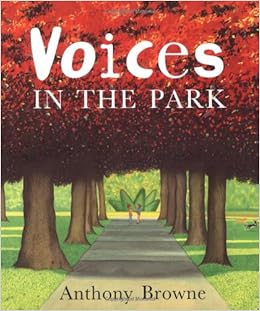
2.) Three picture book codes used in Voices in The Park, codes of position and size, codes of perspective and codes of color were used. Codes of Position and Size was used by positioning the main character in center but your eye is drawn to the characters in the background of the story. Codes of Perspective, were used to change how the reader interprets the scenes. The main characters are positioned in the center of the page but other characters are moving in the background, which changes your perspective of your focus. Codes of Color, were used because this picture book draws one's eye to certain elements in the visual image, and effects the reader's mood. The images affect the reader's mood by the bold, bright colors and expressions on the characters' faces.
3.) The type of "interplay" between the written word and visual images on one of the pages in the Voices In The Park, was symmetrical. Most of the visual images in the story were symmetrical. The visual images were parallel the words written. One visual example, ape is sitting on the bench reading a newspaper and the written words say that "I settled down on the bench to read the newspaper..."
4.) The art movement used in Voices in The Park, was transformation. The apes heads were placed on human bodies.
5.) Ideological Analysis and Structural Analysis of Voices in The Park- shows the different characters perspective of the story. The message is that each character has their own version of the story. The mom and the son have two different perspectives about the dogs and a girl in the park. The son sees a friendly dog stating "they look like old friends and enjoys playing with the girl in the park. Mom states that the other dog is a "scruffy mongrel" and that the little girl was a rough-looking child."
References:
http://ecx.images-amazon.com/images/I/51ittDx%2B7xL._SX258_BO1,204,203,200_.jpg
Serafini, F.,(2014). Reading the Visual: An Introduction to Teaching Multimodal Literacy. Teachers College Press: New York.
Sunday, June 22, 2014
Illuminated Text
Here is my Illuminated Text ! It is about playing dress up! You are never too old to dress up! Dramatic play was favorite thing to do as a kid. This is great video to share with my students to encourage them to remember that dramatic play is an important center to have in your classroom.
Subscribe to:
Posts (Atom)