Monday, June 30, 2014

Analyzing Visual Images and Design in Picturebooks

Begin by considering the format of the images and their placement in the picturebook
  1. Where is the text located? Are the images separated by borders or white space, Why?
        The text is located on the left side of  the page. The images are separated by white spaces.

         2. Are the illustrations double page spreads, single page images, collages, overlapping images, or portraits?
         
         The images are single page images.

        3. Consider the series of images in the picture book. Do the images change over the course of the book? Do they get bigger,  smaller, change?
     
        The images do change over the course of the book. Some of the images get bigger depending on the written text. The image of mummy gets bigger when she yells for Charles.
             
          
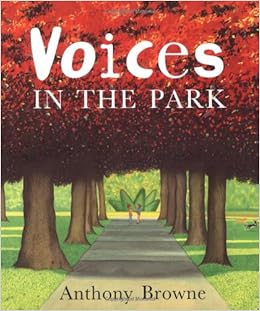
Select an image from Voices In The Park to consider. Use the following questions to guide your analysis.  Take a Screen Shot of the Image and embed the image in your blog. 

  1. What is fore-grounded and in the background? The fore-grounded image is ape (dad) reading the newspaper. The trees and dogs are in the background.

  2. Consider the path your eyes follow as you approach the image. What catches your eye first? Why is that element salient? Your eyes capture the image of the newspaper. The ape reading the newspaper is the image that catches your eye first. The image is salient because it is in the center of the page.

  3. What colors dominate the image? What effect does this have on you as reader? The colors that dominate the image are green background and white newspaper. 

  4. Consider the use of white (negative) space. Are the illustrations framed or full bleed? How does this position you as a viewer? I didn't include the words  on the page, but there was a white space between the image and the words. As the viewer you notice the image before the text.

  5. What is the reality value or level of abstraction? Are the images life-like or stick figures? The images are life-like but with ape faces.

  6. Are there any recurring patterns in the images? The characters in the story are recurring but the background images are not. The background changes with each character's view of the story. The trees are recurring throughout the story.

  7. Are there any anomalous elements? Things that stick out, or seem out of place? Are these important to consider? Things that stick out in this image is the dog in the background. You see the dog moving in the background and it draws your attention.

  8. What is the artist trying to get you to look at through leading lines, colors, contrast, gestures, lighting? The artist is trying to get you to look  the dad reading the newspaper by using bright colors and then focus on the dog in the background.

  9. Are there any recurring symbols or motifs in the images? The recurring motif was the dog and the park. Each character focuses on their experience in the park and with the dog.

  10. Consider the style or artistic choices? Are the appropriate, and how do they add to the meanings of the picture book? The artistic style of the picture book is appropriate. It adds to the meaning of a picture book because the images are a mixture of real images and cartoon images.

  11. How are the images framed? Are there thick borders or faded edges? The images are framed. There is a white space giving the impression of a framed picture.

  12. Consider the setting of the story. How is this realized in the images? Realistically? Metaphorically? The story is could be realistic. 

  13. Consider size and scale. What is large? Why are certain elements larger than others? Does this add to meanings of power, control? The size and the scale change throughout the story. Some of the elements are larger than the other because the illustrator wants you to pay attention to the main character of the story. It changes the meaning of the story, depending on who is narrating.

  14. Consider the viewers point of view. Do characters directly gaze or address the viewer? Are the characters close up or distanced? How does point of view add to relationships with the characters? At times the characters address the viewer. When Mummy is looking for Charles she is looking directly at the viewer. The characters are close up and distracted it depends on the character. The point of view adds to the relationship with the characters depending on which character is telling the story.

Sunday, June 29, 2014

Week 6 Reading

1.) Voices in The Park is an example of a postmodern picture book, because more than one character offers their perspective of the story. The story allows you to choose a character to hear their story.

2.) Three picture book codes used in Voices in The Park, codes of position and size, codes of perspective and codes of color were used. Codes of Position and Size was used by positioning the main character in center but your eye is drawn to the characters in the background of the story. Codes of Perspective, were used to change how the reader interprets the scenes. The main characters are positioned in the center of the page but other characters are moving in the background, which changes your perspective of your focus. Codes of Color, were used because this picture book draws one's eye to certain elements in the visual image, and effects the reader's mood. The images affect the reader's mood by the bold, bright colors and expressions on the characters' faces.

3.) The type of "interplay" between the written word and visual images on one of the pages in the Voices In The Park, was symmetrical. Most of the visual images in the story were symmetrical. The visual images were parallel the words written. One visual example, ape is sitting on the bench reading a newspaper and the written words say that "I settled down on the bench to read the newspaper..." 

4.) The art movement used in Voices in The Park, was transformation. The apes heads were placed on human bodies.

5.) Ideological Analysis and Structural Analysis of Voices in The Park- shows the different characters perspective of the story. The message is that each character has their own version of the story. The mom and the son have two different perspectives about the dogs and a girl in the park. The son sees a friendly dog stating "they look like old friends and enjoys playing with the girl in the park. Mom states that the other dog is a "scruffy mongrel" and that the little girl was a rough-looking child."


References:

http://ecx.images-amazon.com/images/I/51ittDx%2B7xL._SX258_BO1,204,203,200_.jpg
Serafini, F.,(2014). Reading the Visual: An Introduction to Teaching Multimodal Literacy. Teachers College Press: New York.


Sunday, June 22, 2014

Illuminated Text

Here is my Illuminated Text ! It is about playing dress up! You are never too old to dress up! Dramatic play was favorite thing to do as a kid. This is great video to share with my students to encourage them to remember that dramatic play is an important center to have in your classroom.

Week 5

1. Copy and paste a quote from each of the chapters that causes you to have a strong reaction (agreement, disagreement, confusion...) and explain your reaction.

"Language, in both written and oral form has been and continues to be, the primary way humans communicate with one another. Written language has dominated cultural and educational institutions for many centuries, allowing them to record and archive their existence. Print-based, written language is valuable form of representation. Legal documents, the novel, and the college dissertation carry with them social capital and are valuable commercial and social texts."

I strongly agree with this quote. Written language is still the primary form of communication. Students would rather send a text or use social media to communicate. I think the reason is that they can hold several communications at once. 
I also agree with the quote that "print-based, written language is valuable form of representation." Print-based written language is a primary form of communication but is also a way to document history. 

2. Find an image, symbol or motif and upload it to your blog.

3. Conduct a content analysis:  
  • What do you see?
  • light posts, bridge, building, water (river), fence post, bushes, side walk

  • What is the image about?
  • This is a photograph of a bridge in Paris, France.

  • Are there people in the image? What are they doing? How are they presented?
  • There are no people in this image.

  • Can the image be looked at different ways? Explain how the image might be interpreted from two different socio-cultural perspectives. Which perceptive is dominate? 
  • The image a photo taken in Paris, France which a different cultural of it's own. Paris represents a higher social class, sophistication, elegance, city, and high quality. 

  • How effective is the image as a visual message?
     It is very effective as a visual message, because it draws you to the colors, the shadows, the shapes in the photo.

4. Conduct a visual analysis: Use the Chapter on Elements of Art, Design and Visual composition to assist your visual analysis. 
  • How is the image composed? What is in the background, and what is in the foreground?
  • The image is composed of lines, shapes and size. The light post makes a long vertical line in the photo and is a focal point. The shape of the building makes it look like it is in the background. The foreground in this photo is the light post.

  • What are the most important visual elements in the image? How can you tell?
  • The most important visual element in this image is photo is the use of color or lack of color. The use of black and white conveys the light and darken in the photo as well as the time period.

  • How is color used?
  • The photograph is black and white. The black and white photo conveys that it was taking in a historical time period. According to the Serafini text, the color black represents scary, dark moods, night and depressing. The photo to me represents a dark and gloomy day.

  • Can the image be looked at different ways?
  • Yes, this photo can be looked at in different ways. One way is that you pay attention to the light post, if you look at it again you notice the building and the river. 

  • What meanings are conveyed by design choices?
        The orientation of the photo is vertical. The vertical design of this photo draws attention to the light post.
References:
Images: Charles Marville [Public domain], via Wikimedia Commons
http://upload.wikimedia.org/wikipedia/commons/0/09/Arts_et_M%C3%A9tiers_%28Ancien_Mod%C3%A8le%29.jpg

Serafini, F.,(2014). Reading the Visual: An Introduction to Teaching Multimodal Literacy. Teachers College Press: New York.

Monday, June 16, 2014

Week 5: Three Brain Network

 Summary of my Responses 


This little exercise shows that all three brain networks are working when you do something as simple as view an image. Look at your notes below and you will see that each network contributes something vital to the task. This is true of everything we do and everything we learn.

My Three Brain Networks

The Unexpected Visitor

Recognition Network

Items I recognized:
chair, table, picture frames, door, wall, people

Strategic Network

How old are the people in this picture?
young children, 4 or 5 years old, 60 year old man, a teenage girl and women in thirties

What historical period and geographical location do you think this picture represents? Why?
The 1920's Pennsylvania

How might the people be feeling in this picture?
nervous waiting for news

Affective Network

What in particular strikes you about this picture?
the old man walking into the room

Note something about yourself that might have led you to focus on these particular aspects:
Missing my grandfather

Week 4 Reading

1. Copy and paste a quote from the reading that causes you to have a strong reaction (agreement, disagreement, confusion...) and explain your reaction.
"Traditionally, the word literacy has referred to a set of cognitive skills that individuals acquire to function in society, primarily the ability to read and write to a specified degree of proficiency." I agree with this statement that is the traditional definition but I also think it is the definition that most educators still use.  It is the most common definition used in textbooks as well. 

2. Why should educators care about multimodal texts?
Educators should care about multimodal texts because they "will help teachers expand their strategies and skills to help their students successfully read the textual, visual, and design elements of the multimodal texts they encounter."

3. How is your definition of literacy different or similar to the definition of literacy presented in the book? Or how did the reading change or expand your definition of literacy?
I was not aware of the book's definition of literacy. The idea "that literacy  changes depending on one's setting." After reading this definition, I would have to agree. Why, because people are knowledgable about many subjects but I don't think anyone is knowledgeable about every subject. I am very literate when it comes to Art, music , history, English and psychology but when it comes to math I feel illiterate. Math is a subject that I would need to brush up on my skills. I have not had a math class since my first undergrad degree. 

4. How can visual literacy support the development of the kinds of reading and writing we want children to learn through schooling?
Visual literacy can support the development of the kinds of reading and writing we want children to learn through schooling by incorporating other senses. Children will not only be using there eyes but ears to hear a video. Research has shown the more senses you use the more you will comprehend what you are trying to learn.


5. Find an online resources that addresses issues of visual literacy in education link to it or embed it your blog posting and provide a brief explanation of how it relates to this week's reading. 
I think that this video relates to this week's reading because classrooms are changing. Teachers are incorporating more visual literacies into their lesson plans. Children are more engaged when they are given visual tools.

6. Find an images that relates to the ideas presented in this week's reading.
                                     Visual Literacy Image                                                                                                                                                                                                                                                                                      

References:
Damon, K. (n.d). Visual Literacy in the Classroom. (You Tube). Retrieved from http://youtu.be/3F6hGeoCPMk
Serafini, F.,(2014). Reading the Visual: An Introduction to Teaching Multimodal Literacy. Teachers College Press: New York.

Monday, June 9, 2014

Week 3's Reading

1. Copy and paste a quote from each reading that causes you to have a strong reaction (agreement, disagreement, confusion...) and explain your reaction.

"Moreover, assessment is very much about context and needs to take into account the particular
circumstances of the course, the students, and the teacher, as well as the possibilities afforded by
the assignment, the modes, and the medium. Even if it were possible, then, it would be unwise
to apply a set of assessment criteria to all types of assignments at all places."

I  agree with this statement. Assessment is very much about the content because the content determines the assessment. Depending on what the assignment is, will determine how we assess the activity. For example, if the assignment is to create a power point presentation about the life cycle of butterflies a teacher will use assessment tools that assesses the content of the presentation and facts. If the assignment was to create an art project that represented the life cycle of butterflies, the teacher would assess the materials used to create the butterflies.

2. Have you ever ask students to create a multimodal text? Have you ever created a multimodal text for a school related assignment? Described the assignment. What were the learning goals? How was it assessed? Do you feel the assignment improved you or your students comprehension of the content? Why? Why not?

I have never asked students to create a multimodal text. I have created a multimodal text for a grad school class. The assignment was to create a Prezi presentation for my resume. The learning goals were the National Education Standards for Teachers. The presentation was assessed by the how the presentation was designed not by the content. I feel this assignment was a start to understanding how to create a Prezi presentation but this course has helped improved my understanding of a multimodal text.

3. Find an multimodal example of metonymy and embed it in your blog. Is it a good or poor example? Why?
This is an example of a metonymy. The White House is an example of a white house.  The White House is the house of the government but the president as lives there.

4. Find a multimodal example of metaphor and embed it in your blog. Is it a good or poor example Why?
This is a good example of a metaphor because, the lighting is representing a person dancing. The lighting was moving through the sky in waves and rhythms.

5. How does this reading help you think about the use of multimodal text to support writing and content area instruction in school?
This reading has given me insight to the use of multimodal texts. I didn't realize that how many contents a student  could learn through using multimodal texts. This a great tool to teach reading, writing and combing it with digital  media. 

References:
Sorapure, M. "Between Modes: Assessing Student New Media Compositions. Retrieved on 3 June 2014https://www.taskstream.com/Main/main_frame.asp 
Lighting picture: http://carelpress.co.uk/PostersforEnglish/files/Personification.jpg  
White House: http://classroom.synonym.com/DM-Resize/photos.demandstudios.com/getty/article/81/216/87457270.jpg?w=600&h=600&keep_ratio=1